A Neurologist’s Journey to Heal Little Minds
Book Appointment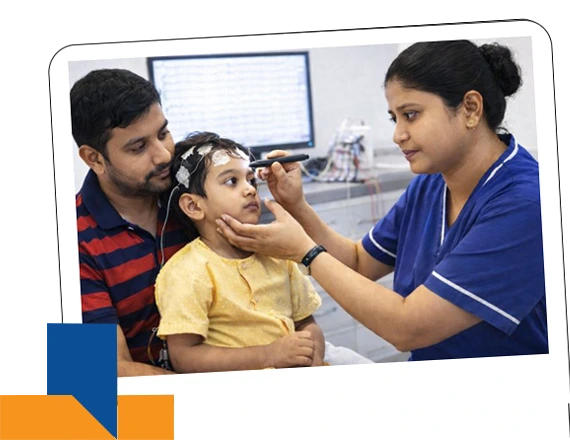
Being a woman, who ardently desired science and compassion to go hand in hand in her daily life, studying Medicine seemed to be the most natural thing to do. Afterall, as Aristotle says, “Where the needs of the world and your talents cross, there lies your vocation.” My journey in the world of Medicine began with Medical College, Kolkata where I was fortunate to spend a span of thirteen years including my Paediatric residency. In lieu of my previous inclination, I was drawn to kids who presented with both acute and chronic neurological conditions, aspiring one day to be known among the Best Paediatric Neurologist in Kolkata.
The scenario which emerged before my eyes was nothing short of a reality check. Coming out of a scientific paradise with controlled cognitive tests to face with the social letdowns and logistical drawbacks was never pleasant. The first setback was in absence of urgent neuroimaging, anaesthetic services, metabolic screening tests and genetic counselling, it was often impossible to get to the root cause of the condition. Secondly, lack of intensive care settings, delayed neuroprotective care and no dedicated work force for neurorehabilitation had its own toll over the final outcome of neurologically challenged kids. Going by data, the burden of neurological disorders in Indian children is enormous with overall prevalence rate of 1-3 % in children < 5 years of age. According to UN estimates, there are around 40 million disabled children in India.
Taking my personal observations into consideration, on one hand, I did get to witness the dramatic recovery of a handful of kids who bounced back to their daily life in no time. But on the other hand, there remained a significant proportion of children with high morbidity, who would need extensive neurorehabilitation, multiple medications and sometimes expensive dietary modifications for rest of their life resulting in severely compensated quality of life since recovery. The situation was made further grim by the widely prevalent staunch social stigma associated with the neurological conditions, the huge emotional and financial burden it imposed on the caregivers and the lack of one stop solution to the neurological conditions as the caregivers desired. In few scenarios where treatment options of orphan drugs, enzyme replacement therapy and gene therapy were available, it was not possible to implement because of the exorbitant cost. In absence of social support and motivation, most of the caregivers were simply not ready for the long course of action and care these kids deserved and it doused even the slow burning fire, if any, in their belly. The result was attrition of the patients from medical care. To add to this quagmire, post-COVID times saw a dramatic increase in the incidence of various neurodevelopmental disorders, namely autism spectrum disorder and attention-deficit hyperactivity disorder and further chaos.
Being fuelled by my motivation and despair alike, I decided to gain deeper understanding from the best people possible. My prayers were answered when I was selected to pursue the prestigious Postdoctoral fellowship course of two years, from the esteemed institution of Christian Medical College, Vellore, known as the cradle of Neurology in India. It provided me with the first-hand knowledge of dealing with various neurological and developmental disorders among neonates, children and the young adult population of various ethnic groups across the globe, notably from the African and Middle-eastern and South-East Asian countries . Working with this subset of population, it made me realise how a great proportion of neurological conditions in paediatrics are completely curable and largely preventable. The road to recovery might be rocky but not entirely unsurmountable. The presence of a robust multidisciplinary ancillary support: neuroradiologists, dedicated neurochemistry and neuropathology services, geneticists, foetal medicine experts, developmental paediatricians, excellent neurointensive care, dedicated neurorehabilitation team, occupation therapists and speech therapists worked wonders. Apart from the extensive array of cases, the journey turned out to be more fulfilling because, with its strong missionary backbone and philanthropic outlook, the institute instilled in us the value of being a “servant-leader” to come close to the community, to render voice to the voiceless, to become a flame of hope for who had lost it. At the end of the day, a child becoming seizure free and returning to his school, children with single and recurrent strokes getting subsequently better on neurorehabilitation, a kid with spastic quadriparetic cerebral palsy learning to sit, child with myasthenia gravis completing his university degree, helping a dyslexic child to procure his texts recorded on audio phones from school are some of the instances which can melt the heart of even a perennial cynic.
But importantly, for those for whom the horizon is not yet bright, it requires immense compassion, patience and empathy to help them accept the diagnosis and the difficult situation they find themselves in. Not to forget, philanthropy is the key to lead forward new trials, to bring orphan disease modifying drugs to reach the needy hands and to build extensive frameworks for these various disciplines to co-exist and work harmoniously. With my new-found experience, I wish to contribute towards uplifting of comprehensive neurological services in Eastern India and cater the need of neurologically challenged children and adolescents through the platform provided by Bhagirathi Neotia Women and Childcare centre, as reflected in the Neotia Bhagirathi New Town doctors list and my role as a Top Child Neurologist in New Town Kolkata. You don’t get to be a good Samaritan in every lifetime and if one gets the part, one must play it with the flair it deserves.